
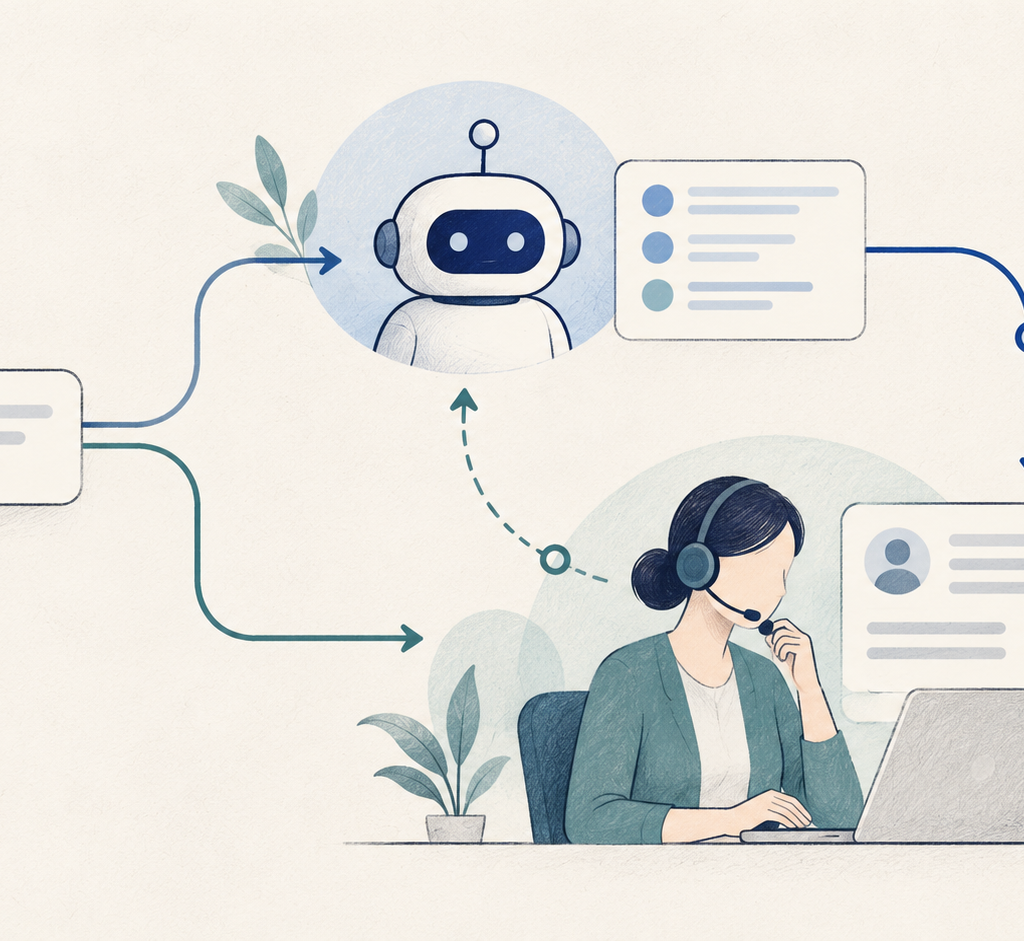
AI in customer service often starts with a familiar failure. A customer repeats a problem after an automated reply, then reaches an agent who cannot see what the system already tried. The handoff still leaves the customer doing the work. The business question is which steps the system should handle, and what must happen when a person needs to take over.
A careful AI in customer service design makes that point of transfer clear before the customer reaches it.
For an owner, the useful starting point is not a claim that every company must automate. It is a map of one service journey, its risks and the result a customer needs. This works for a call center, a retailer, an insurer or a service team inside a larger business.
For a retailer or insurer, AI in customer service may touch a different system or decision. Test the actual path rather than borrowing a call-center example.
Start with the work, not the tool
For one common request, a staff member may need to identify a customer, check an account, explain an option, record the outcome or send an exception to someone with authority. The steps can differ by industry.
List the steps for one common request, such as changing an appointment or checking an order. Mark where a person currently reads information, makes a judgment, updates a system or asks for help. Then ask whether AI in customer service could assist with a specific step without taking away a decision that needs a person.
Define the boundary for AI in customer service
A team could test a system that finds a relevant policy passage for an agent, suggests a reply for the agent to review, or sorts incoming messages by request type. These are examples of possible workflow designs, not claims about a particular product or expected performance. A business should check the actual system and customer process before choosing one.
Write down the boundary in plain language. For example, the system may suggest an answer from approved material, while an employee confirms the information and sends it. It may collect an order number, while the team decides whether a refund is allowed. The line depends on the business, the customer risk and the rules that apply in that country.
Before starting AI in customer service, choose one request type and name the person who can review an uncertain answer.
For generative AI, NIST’s voluntary risk profile, written for use across sectors identifies risks such as confidently incorrect output, privacy exposure, uneven performance across groups or languages, and over-reliance by people. It offers risk-management actions, not a law or a guarantee that a design is safe. Use it to ask what could go wrong in your own service flow, then check the local legal requirements separately.
Make the human handoff work for AI in customer service
A handoff should give the employee enough context to continue. Decide what information moves with the case: the customer’s request, relevant messages, steps already tried, the source of any suggested answer, and the reason the case needs review. Keep only information the employee needs and that the business may properly use.
Set clear handoff triggers before a pilot starts. A person might take over when the customer asks, the system cannot find a supported answer, the request concerns a sensitive account action, or the customer repeats a problem. For a call center, define who receives the case, what appears on the agent’s screen and what to do if that person is not available.
Do not treat a transfer as a complete solution. Ask whether the next person can see the earlier steps and take the next action. If the system sends a case to the wrong queue, hides the customer’s history or gives a confident but unsupported answer, the operating process needs attention along with the technology.
For AI in customer service, the handoff should preserve what the customer has already explained, not create a second intake interview.
Read adoption figures in their own context
Official figures can show why a single adoption story will not describe every market or industry. In June 2026, the Bank of Russia said its first survey of companies found AI use at one in seven enterprises across the Russian economy, with service companies leading. The public statement does not provide a call-center breakdown, so it cannot show how many contact centers use AI or what results they achieve. That context cannot tell an owner whether AI in customer service is right for a particular queue.
U.S. Census Bureau analysis of its Business Trends and Outlook Survey reported that business AI use varied by company size and sector during the period from December 2025 to May 2026. The survey question changed in November 2025 to include use in any business function. Those U.S. and Russian figures use different surveys and should not be compared as if they were one measure. Neither tells an individual owner whether a proposed customer-service change will help.
For a company operating in Russia, use current local requirements, systems and service data to assess a specific workflow. Do not transfer a U.S. assumption about law, language, data handling or customer expectations. The same caution applies when adapting an approach for Georgia or another market.
Measure AI in customer service by the full outcome
Before testing AI in customer service, save a baseline for one request type. Track whether the customer got the right outcome, how often the customer had to contact the business again, whether a person took over, how much context arrived with the case, and what the employee had to correct. Also record the cost of the system, integration, review, staff training and ongoing supervision.
Set a stop condition as well as a goal. Pause the test if errors increase, sensitive information appears where it should not, customers cannot reach a person, or staff have to repair too many suggestions. Decide who reviews those signals and who can switch the system off. A faster first reply does not prove that the whole service improved.
A team assessing AI in customer service should compare the customer’s final outcome with the extra work the system creates for agents.
Use a small test with a defined owner and a clear comparison. Review a sample of cases before and during the test. Ask agents what changed in the work, inspect complaints and repeat contacts, and confirm that the customer can reach the right person. Keep a record of what the system did and what a person changed or overrode.
Before expanding AI in customer service to another country or channel, repeat the checks against local rules, language and escalation needs.
Make the next decision specific
After the test, choose among keeping the step, changing its boundary, improving the underlying process or stopping the use. If agents cannot find current guidance, fix the source material before asking AI to summarize it. If cases arrive without the information needed to act, improve the intake. If the system’s suggestions need constant correction, do not label that rework as saved time.
AI in customer service is a decision about how the service runs as much as a software decision. It changes who handles each step, what information moves between systems, who owns exceptions and how quality is checked. DBG360 can help map the customer journey, assess the handoffs and align processes, people and connected systems. If your team is weighing a pilot, book a discovery call to discuss the workflow and the decision you need to make.